Interview about SEO with Managing Director Matthias Petri
Today, an interview with me as an SEO expert was published on Seo-Inform.de. Since the answers provide a good overview of our stance on current SEO topics, I am also publishing my responses here. If you find the topics about the current challenges in the age of AI and our approaches to still generating visibility and clicks for clients interesting, feel free to read on.
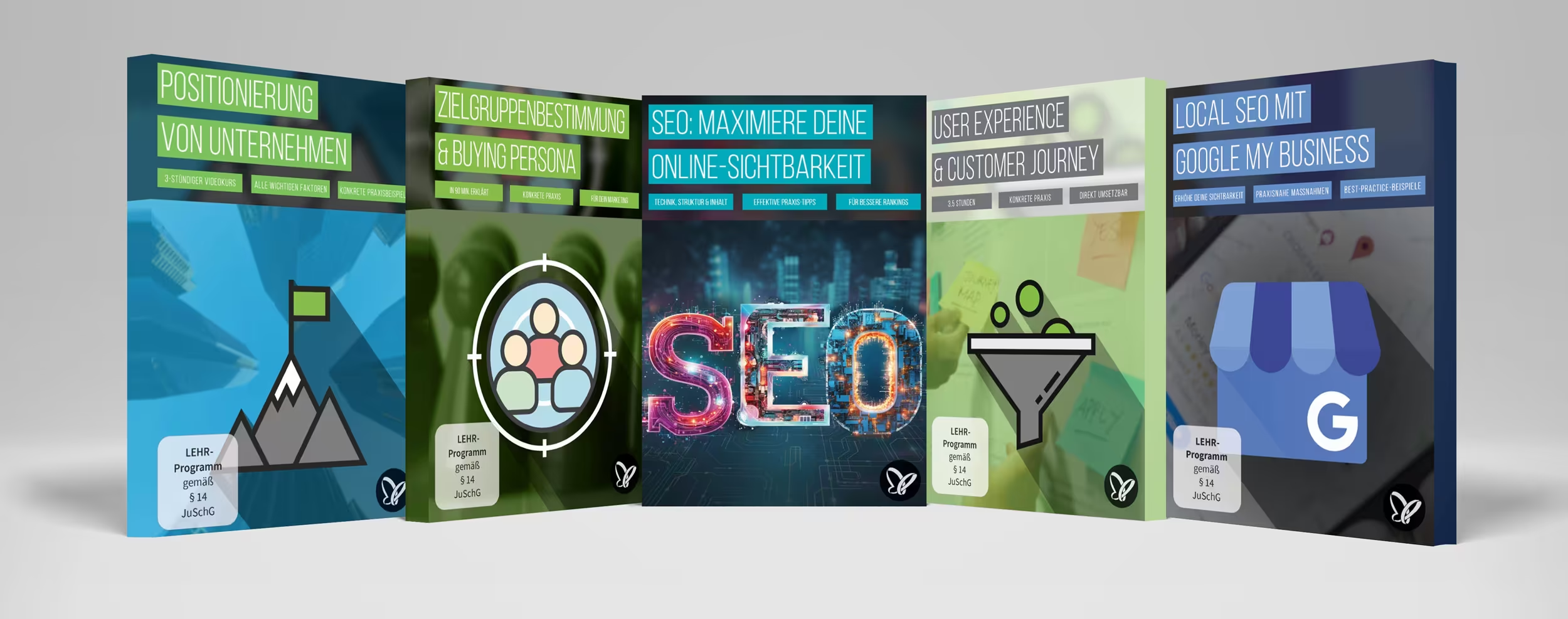
Matthias Petri is the managing director of the agency 4eck-Media.de and operator of the multilingual e-learning and content portal TutKit.com. He was a speaker at the SEO Day in Cologne and has published several trainings on SEO, local SEO, user experience and customer journey, target audience determination and buying persona, as well as company positioning and brand building.
Your view on SEO and your agency:
How did you get into SEO?
We are in the agency business, but we are also actively involved in the market with our own project TutKit.com. We founded the portal in 2015. Therefore, we were also interested in increasing its visibility. That was the starting signal for us to professionally engage with SEO.
What still excites you about it?
It feels good when things work as planned. SEO is not just about generating visibility for websites for me. The use of SEO tools is also a form of quality management for websites. The tools demand valid code, a clean structure, content that is understandable and aligned with keywords and search intent, as well as the best possible user experience, including high page speed. Professional SEO forces website operators (and agencies) to adhere to technical web standards and user-focused quality criteria.
What motivated you to start the agency?
We started a forum for image editing with Photoshop back in 2002. Through PSD-Tutorials.de, our users could also sell learning DVDs (later downloads) on photo optimization and web design using Photoshop, for example. We repeatedly received inquiries asking if we could be booked for customer projects. This led us to found our agency 4eck Media on January 1, 2010.
How do you classify your agency?
Initially, we were mainly focused on full-service. Today, we position ourselves on specialized competencies in SEO, PageSpeed optimization, and multilingualism.
To be honest, customers from our region are not specifically asking for multilingual capabilities or an improvement in loading speed. Companies continue to inquire because they want a relaunch, need an online shop developed, or simply want to improve their visibility on Google. From day-to-day experience, it still feels like full service, even though we certainly bring the deepest competencies and experiences in SEO topics.
What major challenges are agencies like yours currently facing?
- Many customers expect immediately visible results, even though SEO takes time. Therefore, we invest a lot in education, realistic timelines, and clear communication. Honestly, the AI responses are also changing the conditions even more. Zero-click searches were already at up to 70 percent before the AI overviews, depending on the topic. With the AI responses, even fewer clicks are directed to the websites. Expectations for planned SEO successes need to be readjusted. Omnichannel approaches are becoming more important.
- In the past, launching a website was often enough as long as it looked reasonably good. Nowadays, structure, loading time, UX, mobile responsiveness, semantics, security, accessibility, and content quality are aspects that truly make a website good. These requirements have not only become more technical but also significantly more time-consuming and complex to explain.
- AI is currently changing not only processes but also customer expectations. Some customers believe that with a few clicks, texts, images, or entire concepts can be automated. This is partially true. As a result, there is a tendency to discuss services on offer, with the impression that everything can be done faster and cheaper. One task for agencies will be to measurably prove the real added value for customers.
What strategies does your SEO agency follow?
We combine data-driven analysis with pragmatic implementation. The focus is on:
- Optimize technical foundation (Pagespeed, Core Web Vitals, clean structure)
- Content with added value, tailored to the target audience.
- UX improvements along the customer journey, so that more visitors trigger the desired behavior.
- Understandable SEO processes where the client always knows what is happening and why.
What is your focus in SEO?
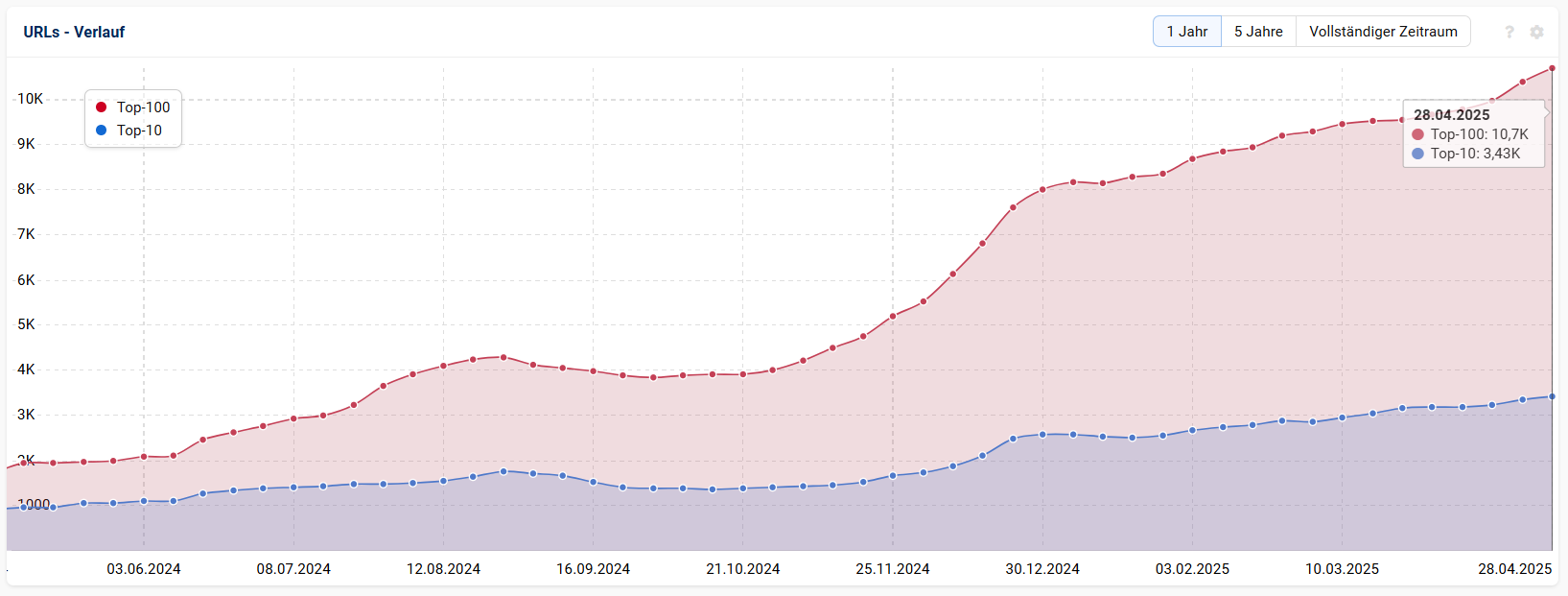
On-page: Structure, speed, and content. We ensure that the site architecture is well thought out, that content is prioritized sensibly, and that loading times do not pose an obstacle—especially for mobile users. We make the results of these optimizations transparent by presenting tool-based score improvements in OnPage, PageSpeed, security, etc. And after some time, the planned ranking improvements often materialize, the number of URLs in the top 10 increases (as exemplified in the following screenshot), and the rise in clicks becomes visible in the Search Console.
Offpage: We actually only do Offpage passively for our portal TutKit.com, less for our clients. The reason is that we ourselves are contacted almost daily regarding whether we want to conduct certain link building campaigns. Our portal operates in 28 languages and has quite a good international reach. Therefore, we are on the radar of many SEOs who engage in Offpage sooner or later.
Your perspective on your customers:
What do you currently see as the biggest challenges for end customers?
Many companies underestimate the effort required for sustainable SEO success. They expect results without providing internal resources – neither for content creation nor for technical implementation. Furthermore, there is often a lack of understanding that SEO is not a project with an end date, but a continuous process. Therefore, we see our role as a translator and companion – not just as a service provider.
The biggest challenge I see for end customers is generating any significant organic clicks at all in the age of AI responses. The trend we have observed since the beginning of the year represents an unprecedented change in the rules of the game for website operators and agencies. One example: In our client projects, we see a decline of 20 to 50 percent in clicks over a three-month period compared to the previous year, even though visibility according to Sistrix has remained nearly the same.
What advice can you give to SEO professionals in industry and commerce?
If the answers on Google shift towards AI-generated responses, it is essential to start optimizing websites for this now. Structured data, well-maintained FAQ snippets, how-to markup, and speakable tags are a must—those who want to be mentioned in AI-generated responses from Google & Co. need to communicate in a machine-readable way.
SEO is not an end in itself. Every measure needs to be related to specific business goals. In our current relaunch project, a website is being completely rebuilt for technical brilliance, high page speed, security, and accessibility. The content will be expanded into five languages and enriched on all pages with FAQ boxes and other elements designed for optimization for AI response systems. In my opinion, SEO professionals should focus on these topics.
And never forget: target customers should perform the desired action on the website. What is currently preventing them from doing so? How can I support the user in their customer journey?
What tools do you use?
- Seobility: for on-page optimization in technology & meta, structure, and content. It has become established with us mainly because of its gamification approach.
- Audisto: specifically for TutKit.com, because we currently have over 300,000 URLs and require more specialized evaluations.
- Sistrix: For keyword and ranking monitoring. It is the gold standard in Germany.
- PageSpeed Insights: For improving load speeds. Important: not only check the homepages, but also other page types. And then work through the recommendations to improve the PageSpeed.
- AI tools: especially ChatGPT, Claude, and Gemini for texts. Midjourney, Adobe Firefly, and Freepik for images, with ChatGPT also becoming really good for images nowadays.
Your perspective on …
… Backlinks: What characteristics / KPIs make a backlink so valuable?
The domain rating of the website is important. In backlink campaigns, the domain rating of the other website should not be too far from your own rating. Higher is always welcome, of course. Additionally, the website should not be too thematically distant from your own. A tip: Anyone engaging in link exchange campaigns, etc., should always check that the page where the link is placed is still indexed by Google.
… Keywords: What importance do keywords have for an SEO campaign?
Keywords are still important, but no longer the only deciding factor. We work with search intentions, not just word combinations. The classic keyword density is irrelevant if the page does not meet the user’s needs.
Especially with translations, one should also pay attention to contextual accuracy. One example: What sounds like a natural translation to us may never be searched for by natives. Therefore, always check the search volume of the keywords.
… Keyword Analysis: What developments are there in keyword analysis?
Semantic clusters, entities, and intent analysis are more important today than exact matching. Additionally, we see a shift towards SERP analysis: What does Google show for this term at all – and what does it not show?
… SEO campaign: How do you measure the success of an SEO campaign?
We jointly define KPIs before the campaign starts: organic traffic, visibility, conversion goals. Then it is regularly reviewed – with reports that include not only rankings but also real business value… ideally clicks and then purchases, contact inquiries, or other desired behaviors.
Your view on the following trends:
What influence does AI have on SEO?
AI is primarily changing content creation and user expectations. Texts can be produced faster, which increases quantity but does not automatically guarantee quality. The key is to use AI correctly: for idea generation, structuring, snippets, or transcriptions. At the same time, human input becomes more important – for tonality, structure, and real differentiation. AI is a tool, not a replacement for strategy or experience.
How has Google changed since ChatGPT?
Many websites have used ChatGPT for immense content scaling. We have as well. Without AI tools, for example, large-scale machine translations would not be possible at all. And with the help of ChatGPT or using the API to OpenAI, content creation is further automated. Google needs to find ways to position the best results for users at the top. It’s probably not so easy when more and more content needs to be indexed every day. Therefore, it is also important to address the metrics that are crucial for positive user signals, for instance, by increasing the duration of visits on websites through the placement of video-based content.
Google itself is under pressure as more and more users are conducting their searches in ChatGPT. User behavior is slowly shifting. A solution that Google has found is not really appealing to any of us: now there are AI-generated answers with AI Overviews. This makes it even more important to optimize websites for the needs of AI answer systems.
Other SEO experts see the following trends. Can you say something about each of them?
Voice search:
We are observing the trend, but reacting pragmatically. Voice searches aim for concrete answers. Therefore, we specifically optimize for FAQs, Featured Snippets, and structured data – but without aligning all content to this.
Internal linking and backlinks:
Both are essential. Internal linking provides structure and topical authority. Backlinks demonstrate relevance in an external context. Those who thoughtfully consider both have advantages in rankings and user guidance. How do AI-generated summaries of websites change the SEO landscape? For some sites, it’s a gift; for others, a traffic killer. SEO must be thought of as an omnichannel approach in 2025: how can traffic be directed to the website not only from Google but also from social channels, and how can one get included in AI responses, etc.
What significance does the integration of different media types have for you?
They meaningfully complement texts – especially in the case of complex topics or products. YouTube SEO, video snippets, and integrated explanatory videos increase dwell time and relevance. In the aforementioned relaunch project, we are incorporating video-based sections with vertical format style videos, as users are familiar with from TikTok and similar platforms. Therefore, we consider video content to be important.
Mobile-First: What particular aspects should be considered?
Pay attention to loading times. For computer resolutions, most achieve good loading times. However, mobile PageSpeed is especially crucial. Also, conduct testing of the pages on smartphones. Companies tend to test everything on computers, but that is not mobile first. We regularly check mobile loading times, finger-friendliness, font sizes, and visual stability with real devices, not just with tools.
Data protection and security:
Especially the smaller projects manage quite well without cookies. When you access a website without a cookie banner, I find that quite pleasant. Otherwise, data protection is always a topic, if only to avoid warnings. Security is important and does not seem to be prioritized on many websites. Those who run a check, for example on securityheaders.com with their website URL, already receive a first indication that security aspects have been overlooked. That is why testing tools are so important. For our large projects, we use Symfony Insights, which performs 130 security-based checks for the backend code.
UX as a Ranking Factor:
UX starts with the fact that, as a website user, I must immediately grasp, without much thought: What is the offer or service of the website operators, and do I belong to the target audience? Unfortunately, not all websites answer this question. Google measures behavior. Anyone who leaves a page because it is confusing or the content is not quickly understandable will ultimately lose. Therefore: Good layout, clear structure, understandable content, and mobile usability are part of the SEO strategy.
Automation and Feed Management:
This is relevant for larger projects and e-commerce, as we see with TutKit.com. Product feeds, structured data, and automatic updates save time – when they are well-maintained. We rely on a combination of automation and manual quality assurance. The importance is indeed relatively high.
What is your outlook?
What do you see as the SEO trends for the future?
Omnichannel SEO and SEO for AI response systems.
What will your next training be about?
It is about paid ads for Google, Meta, and Co. and the use of AI for optimization and automation in ad placements. As organic visibility decreases for many websites, companies will inevitably have to pay for clicks. As an agency, we also want to deliver the best possible results for our clients.